
Torlon® PAI vs. Vespel®
Compare Torlon® PAI and Vespel® SP-1 polyimide to identify the best option for your project
Differences Between Torlon® PAI and Vespel® SP-1
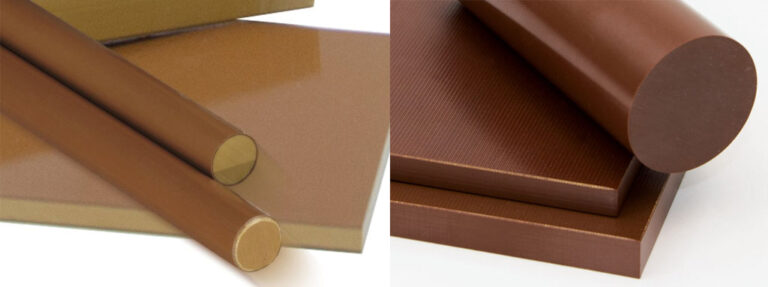
Torlon® PAI (polyamide-imide) is an extremely strong and stiff plastic material. It is often used in elevated temperature environments where other thermoplastics would lose their mechanical properties.
Torlon® PAI is a very dimensionally stable material with an extremely low coefficient of thermal expansion (CTE) making it an excellent choice for applications that require machining to tight tolerances.
DuPont™ Vespel® SP-1 has moderate strength and modulus, allowing it to have excellent sealing performance. This unfilled polyimide has good wear resistance and thermal and electrical insulating characteristics. Vespel SP-1 has an operating temperature range from cryogenic conditions to 260°C (500°F) for many applications.
Available stock shapes include isostatically molded billet and unidirectionally pressed slab specified as Type IM and Type IP respectively per ASTM D6456-10 / MIL-R-46198. Vespel® SP-1 is specified as Class 1 per AMS 3644G.
Vespel® SP-1 shapes are commonly selected for semiconductor manufacturing components including test sockets and wafer handling devices. It is also used for a wide range of aircraft and spacecraft applications.
Its inherent resistance to stress relaxation enables DuPont™ Vespel® to maintain long-term sealing performance.
Torlon® PAI Material Characteristics |
Vespel® SP-1 Material Characteristics |
|---|---|
|
|
Torlon® PAI Applications |
Vespel® SP-1 Applications |
|
|
Torlon® PAI Common Brands |
Vespel® SP-1 Common Brands |
| • Torlon® PAI, Duratron® PAI | • DuPont™ Vespel® |
Typical Properties of Torlon® PAI vs. Vespel® SP-1
| Property | Units | ASTM Test |
Torlon® PAI (Duratron® T4203 PAI) |
Vespel® SP-1 |
|---|---|---|---|---|
| Tensile strength | psi | – | 20,000 | 12,500 |
| Tensile elongation | % | – | 29 | 7.5 |
| Flexural strength | psi | D790 | 24,000 | 16,000 |
| Flexural modulus of elasticity | psi | D790 | 600,000 | 450,000 |
| Compressive strength (10% deformation) 73°F | psi | D695 | 24,000 | 19,300 |
| Izod impact (notched) 73°F | ft-lbs/in of notch | D256 | 2 | 0.8 |
| Coefficient of linear thermal expansion | in/in/°Fx10-5 | – | 2.1 | 3 |
| Heat deflection temperature (66psi / 264psi) | °F | D648 | – / 532 | – / ~680 |
| Dielectric strength (short term) | V/mil | D149 | 580 | 560 |
| Water absorption (immersion 24 hours) | % | D570 | 0.4 | 0.24 |
Values may vary according to brand name. Please ask your Curbell Plastics representative for more specific information about an individual brand.
Know what you need? Shop our Torlon® PAI and Vespel® plastics online, or Contact Us with questions about these plastic materials.
Additional Material Comparisons
Not sure which materials best fit your needs?
Our experienced sales and technical teams are available to assist you with material selection challenges.