
DuPont™ Vespel® Over-Molded Assemblies: Elevated Performance, Design Flexibility, and Value
DuPont™ Vespel® SP and SCP polyimides are widely recognized as the materials of choice for many demanding applications where metals, ceramics, and other plastics would quickly fail. Some of the unique performance characteristics of Vespel® materials are listed below.
Performance Characteristics of DuPont™ Vespel® Materials
- Wide operating range – from cryogenic temperatures to 500 °C for many applications, with continuous service temperatures up to 300 °C in air
- Friction and wear performance including very high pressure-velocity limits without the need for external lubrication
- Dimensional stability
- Creep resistance
- Radiation resistance
- Low outgassing
- Flammability characteristics
- High dielectric strength
Because of these properties, Vespel® components have been successfully used in a wide range of devices including military equipment, aircraft, spacecraft, semiconductor manufacturing machinery, and recreational vehicles.
How Vespel® Over-Molded Assemblies Work
Until recently, the practical applications for Vespel® have been bounded by two design considerations. First, Vespel® is a premium material, with unit‑volume costs that reflect its advanced performance characteristics relative to other engineering plastics. Second, because Vespel® does not melt, it can’t be processed into complex parts using fast cycling thermoplastic injection molding machinery.
DuPont™ Vespel® OMA (over-molded assemblies) largely overcome these limitations, allowing for the use of Vespel® in a broader range of applications. The OMA process involves first manufacturing a Vespel® SP or SCP component to be used for part surfaces where the performance of polyimide is required due to localized mechanical and/or thermal stresses. The bulk of the part is then injection molded from a traditional thermoplastic, allowing for complex geometries and low manufacturing costs. The finished assembly consists of a Vespel® SP or SCP internal component permanently secured to an over-molded thermoplastic part.
Vespel® OMA solutions provide a strong value proposition for a variety of mechanical, tribological (friction and wear), and electrical applications. For example, illustration 1 shows a lead screw nut that consists of a replaceable Vespel® OMA part fastened to a metal frame. This particular lead screw operates in vacuum where the use of liquid lubricants is undesirable.
Applications for Vespel® OMA Components
The surface of the OMA nut that contacts the metal lead screw is manufactured from Vespel® SP-3, which has outstanding friction and wear characteristics in vacuum conditions without the use of external lubrication. The bulk of the OMA lead screw nut is made from molybdenum disulfide filled-nylon, which is over-molded to the Vespel® SP-3. MD-filled nylon is cost effective and it can easily be injection molded to the required geometry.
Using Vespel® for the wear surface in this application is particularly important since the frictional heat associated with the high localized stresses where the nut contacts the screw threads would quickly result in a lower performing plastic softening and failing. All-metal lead screw nuts may cause severe wear from galling, especially in the absence of liquid lubricants.
This application illustrates the benefits of Vespel® OMA since the relatively expensive Vespel® SP-3 is only used for the surfaces in direct contact with the metal screw and the bulk of the part is made using nylon, a traditional melt-processable thermoplastic.
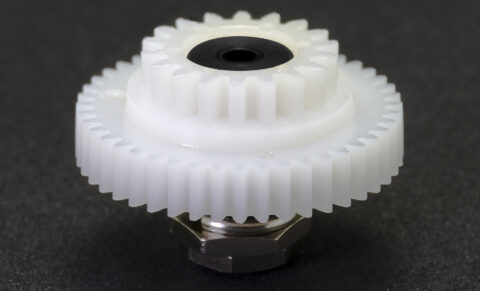
Illustration 2 shows a gear that was manufactured using Vespel® OMA. In this example, the central section of the gear is made from Vespel® SP-21, which has the friction and wear performance required for direct contact with a rotating metal shaft. The gear operates at loads and speeds such that the pressure-velocity conditions would quickly degrade traditional thermoplastics. The Vespel® SP-21 bearing in the center was over-molded with acetal (a low cost, easily moldable thermoplastic) to create the finished assembly.
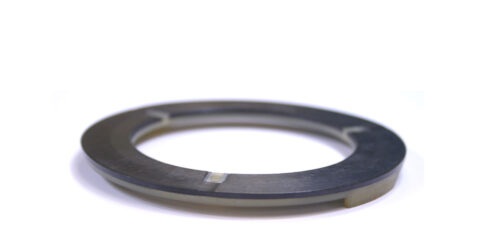
Illustration 3 shows an OMA thrust washer made using Vespel® SP-21 for the wear surface and glass-filled nylon for the body of the part. Similar to the OMA gear example, Vespel® SP-21 is used for the surface with the demanding tribology requirements and lower cost, melt-processable nylon is used for the bulk of the part.
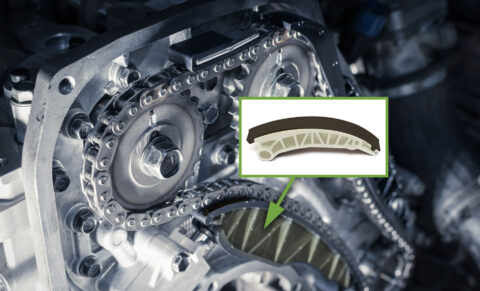
Another example of a Vespel® OMA solution is the chain tensioner shown in illustration 4, made using a Vespel® SP-21 wear surface over-molded with glass-filled nylon. Similar to the previous examples, a friction and wear grade of Vespel® is used for the contact surface that experiences aggressive sliding wear and a traditional thermoplastic is used for the bulk of the part where low cost and the ability to be molded to a complex shape are required.
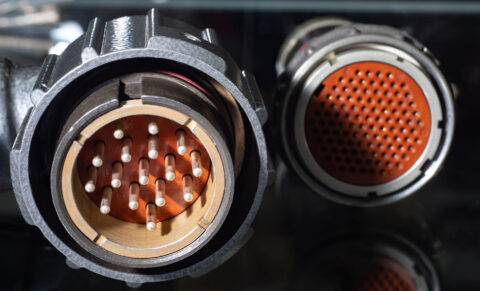
Illustration 5 shows aerospace electrical connectors manufactured using a Vespel® OMA solution. The electrically insulating components (brown color) that contact the metal conductive elements are made from Vespel® SP-1, which has outstanding electrical properties and flammability characteristics. This material can also operate at the elevated temperatures required for the application. The Vespel® SP-1 insulators are over-molded with a low cost fire-retardant glass-filled nylon to achieve the finished part geometry.
It is important to note that Vespel® SP-1 has the ductility to allow for easy press fit assembly of the metal conductive elements in the connectors. Ceramic insulators can easily crack during press fit assembly with metal parts due to the brittle nature of ceramics.
The purpose of this article has been to provide an overview of Vespel® OMA solution including some examples of applications for Vespel® over-molded assemblies.
Learn More About Vespel® Over-Molded Assemblies
For additional information about DuPont™ Vespel® over-molded assemblies or for specific application questions, Ask a Plastics Expert or call 1-800-553-0335 to speak with a sales representative.
Curbell Plastics has been designated by DuPont as its authorized distributor of Authentic DuPont Vespel in the states of Alaska, Arizona, Arkansas, California, Colorado, Hawaii, Idaho, Illinois, Indiana, Iowa, Kansas, Kentucky, Louisiana, Michigan, Minnesota, Missouri, Montana, Nebraska, Nevada, New Mexico, North Dakota, Ohio, Oklahoma, Oregon, South Dakota, Texas, Utah, Washington, Wisconsin, and Wyoming.
©2026 DuPont. All rights reserved. DuPont™, the DuPont Oval Logo, and all trademarks and service marks denoted with ™, ℠ or ® are owned by affiliates of DuPont de Nemours, Inc. unless otherwise noted.
DuPont believes this information to be reliable. It may be subject to change as additional knowledge and experience are gained. It is not intended as a substitute for any testing you may conduct to determine for yourself the suitability of our products, alone or in combination with other products, for your particular purpose. The DuPont product shown in this literature may not be available for sale and/or available in all geographies where DuPont is represented. The claims made may not have been approved for use in all countries or regions. Since conditions for use are outside DuPont’s control, DUPONT DE NEMOURS, INC. AND ITS AFFILIATES MAKE NO WARRANTIES, EXPRESSED OR IMPLIED, INCLUDING BUT NOT LIMITED TO WARRANTIES OF MERCHANTABILITY OR FITNESS FOR A PARTICULAR PURPOSE AND ASSUMES NO LIABILITY IN CONNECTION WITH ANY USE OF THIS INFORMATION OR PRODUCT. This information is not intended as a license to operate under or a recommendation to infringe any trademark, patent or technical information of DuPont or other persons covering any material or its use.

About the author
Dr. Keith Hechtel is Vice President of Business Development & Marketing for Curbell Plastics, Inc., based in Orchard Park, NY. Dr. Hechtel has a Bachelor of Science degree in Geology, a Master of Science degree in Industrial Technology, a Doctor of Business Administration degree, and over 30 years of plastics industry experience.
Much of his work involves helping companies to identify plastic materials that can be used to replace metal components in order to achieve quality improvements and cost savings. Dr. Hechtel is a recognized speaker on plastic materials and plastic part design. He has conducted numerous presentations for engineers, designers, and fabricators in both industrial and academic settings. Contact Keith.
Not sure which materials best fit your needs?
Our experienced sales and technical teams are available to assist you with material selection challenges.